Design history · 1980s–present

Bruce Mau

The Canadian designer whose book work with Rem Koolhaas and Zone Books made design an act of intellectual co-authorship — not decoration, but argument.

Bruce Mau (b. 1959) is the Canadian graphic designer who built the visual identity of Zone Books from 1985 and co-authored S,M,L,XL (1995) with Rem Koolhaas — a 1,376-page book that reshaped how architecture practices document their work. His An Incomplete Manifesto for Growth (1998) and the Massive Change project (2004) extended his practice into design as a form of systemic social inquiry.

Key facts

Born
25 October 1959, Pembroke, Ontario, Canada
Nationality
Canadian
Era
Postmodern · editorial design · brand systems · design for social change
Studios
Fifty Fingers (1980–1982) · Pentagram London (1982–1983) · Public Good Design (1983–1985) · Bruce Mau Design, Toronto (1985–2010) · Massive Change Network, Chicago (2010–) · Bruce Mau Studio (2020–)
Known for
S,M,L,XL with Rem Koolhaas (1995) · Zone Books visual identity · An Incomplete Manifesto for Growth (1998) · Massive Change (2004)

01

Biography

Bruce Mau was born in Pembroke, Ontario in 1959 and grew up in Sudbury, where he attended Sudbury Secondary School. He studied advertising at the Ontario College of Art and Design in Toronto under Terry Isles, leaving before graduating in 1980 to join the Fifty Fingers design group.

In 1982 he moved to London to work at Pentagram. After returning to Toronto, he co-founded Public Good Design and Communications, a studio oriented towards public-sector and non-profit clients, before leaving in 1985 to design Zone 1/2: The Contemporary City. That commission — an oversized anthology of critical writing on urbanism, edited by Jonathan Crary, Michel Feher, Hal Foster and Sanford Kwinter — established the visual language he would develop across more than 100 Zone Books volumes over the following two decades.

The Zone collaboration brought him into contact with Rem Koolhaas, whose writing appeared in Zone 1/2. The two began working together in the early 1990s; the result was S,M,L,XL, published in 1995 by Monacelli Press and 010 Publishers. The 1,376-page book documented OMA’s projects across two decades and was designed by Mau as an intellectual argument in its own right. He was credited as co-author.

In 1991 he became creative director of I.D. magazine, a role he held until 1993. He wrote An Incomplete Manifesto for Growth in 1998; the 43-point document on sustaining creative practice spread through design education and was eventually translated into dozens of languages.

In 2003 he co-founded the Institute Without Boundaries with George Brown College in Toronto, a postgraduate programme built around applied research into large public problems. The institute produced the Massive Change project — an exhibition, radio series, website and Phaidon Press book (2004) — examining design as a force for reshaping the world rather than decorating it.

In 2010 he moved to Chicago with his wife Bisi Williams and co-founded Massive Change Network. He served as Chief Design Officer at Freeman from 2015. In 2020 he founded Bruce Mau Studio.

02

Design philosophy

Mau’s central argument, evident across his career, is that design is not primarily a visual discipline but a form of intelligence — a way of asking questions and organising responses to complex problems. His 1998 manifesto makes this explicit through its structure: a list of open questions and provocations rather than resolutions.

His collaboration with Zone Books was the formative experience. Working alongside Crary, Kwinter and the other editors, he developed an approach to book design as intellectual co-authorship — the designer as a participant in the production of meaning rather than its container. Mau has described Zone as the place where he understood that design could be “both producer and critic simultaneously.”

S,M,L,XL extended this into architectural publishing. Mau’s design for the book — dense typography, images and text in continuous collision, a format that refused easy navigation — argued that OMA’s practice resisted the clean monograph treatment. The book’s illegibility at points was part of its argument.

Massive Change shifted this thinking to a different scale. If Zone was about design as intellectual work, Massive Change was about design as systemic intervention: “Massive Change is not about the world of design. It is about the design of the world.” The distinction between the visual surface and the underlying structure — economic, biological, urban — became Mau’s explicit subject.

03

Key works

Zone Books visual identity (1986–2004) — Mau designed Zone 1/2 in 1986 and went on to direct the visual identity of the series across more than 100 volumes. The Zone visual language — heavy sans-serif type, dense layout, an oversized format that announced seriousness — became recognisable internationally.

S,M,L,XL (1995) — 1,376-page collaboration with Rem Koolhaas and OMA, published by Monacelli Press and 010 Publishers. Mau credited as co-author. Reshaped architectural publishing.

An Incomplete Manifesto for Growth (1998) — 43 principles for creative practice, published in I.D. magazine. Translated into dozens of languages; used as a design project worldwide.

Massive Change (2004) — Phaidon Press book and exhibition at the Vancouver Art Gallery. An inquiry into design as systemic world-making. Produced through the Institute Without Boundaries.

Identity programmes — Walt Disney Concert Hall (Frank Gehry); Netherlands Architecture Institute; Art Gallery of Ontario; Gagosian Gallery; Coca-Cola international sustainability platform (2009).

Iconic works

Zone 1/2: The Contemporary City, designed by Bruce Mau, 1986

Zone 1/2: The Contemporary City

1986

Bruce Mau's first major design project after founding his Toronto studio in 1985 was the visual identity and design for Zone 1/2: The Contemporary City — a large-format anthology of critical writing on urbanism edited by Jonathan Crary, Michel Feher, Hal Foster and Sanford Kwinter. The book drew on contributors including Rem Koolhaas, Gilles Deleuze and Paul Virilio, and Mau's design — aggressive typography, dense layering, a format that treated the page as an intellectual space rather than a container for text — announced the visual language that Zone Books would carry across more than 100 subsequent volumes. The commission led directly to Mau's long collaboration with the Zone editorial team and, through them, to Koolhaas.
Zone 1/2: The Contemporary City (Zone Books, 1986). Cover design, Bruce Mau. · Bruce Mau / Zone Books, 1986. Publisher image. Statutory educational licence. · AU statutory
S,M,L,XL book by Rem Koolhaas and Bruce Mau, Monacelli Press 1995

S,M,L,XL

1995

Published in 1995 by Monacelli Press (New York) and 010 Publishers (Rotterdam), S,M,L,XL is a 1,376-page collaboration between architect Rem Koolhaas, the Office for Metropolitan Architecture, and Bruce Mau. The book compiles two decades of OMA projects — drawings, photographs, essays, diary entries, travelogues, cartoons — and organises them by scale rather than chronology. Mau's contribution was the design system: radical typography, dense image-text layering, a deliberately unstable reading path that positioned the book as an architectural argument rather than a monograph. The first printing of 30,000 copies sold out; a second printing of 70,000 followed. Mau was credited as co-author alongside Koolhaas, an unusual acknowledgement of the designer's intellectual role. The book reshaped how architecture practices document their work and established a template for subsequent large-scale design-led publishing.
S,M,L,XL (Monacelli Press / 010 Publishers, 1995). Design: Bruce Mau; text: Rem Koolhaas / OMA. · Bruce Mau / Rem Koolhaas / Monacelli Press, 1995. Cover image via Internet Archive. Statutory educational licence. · AU statutory
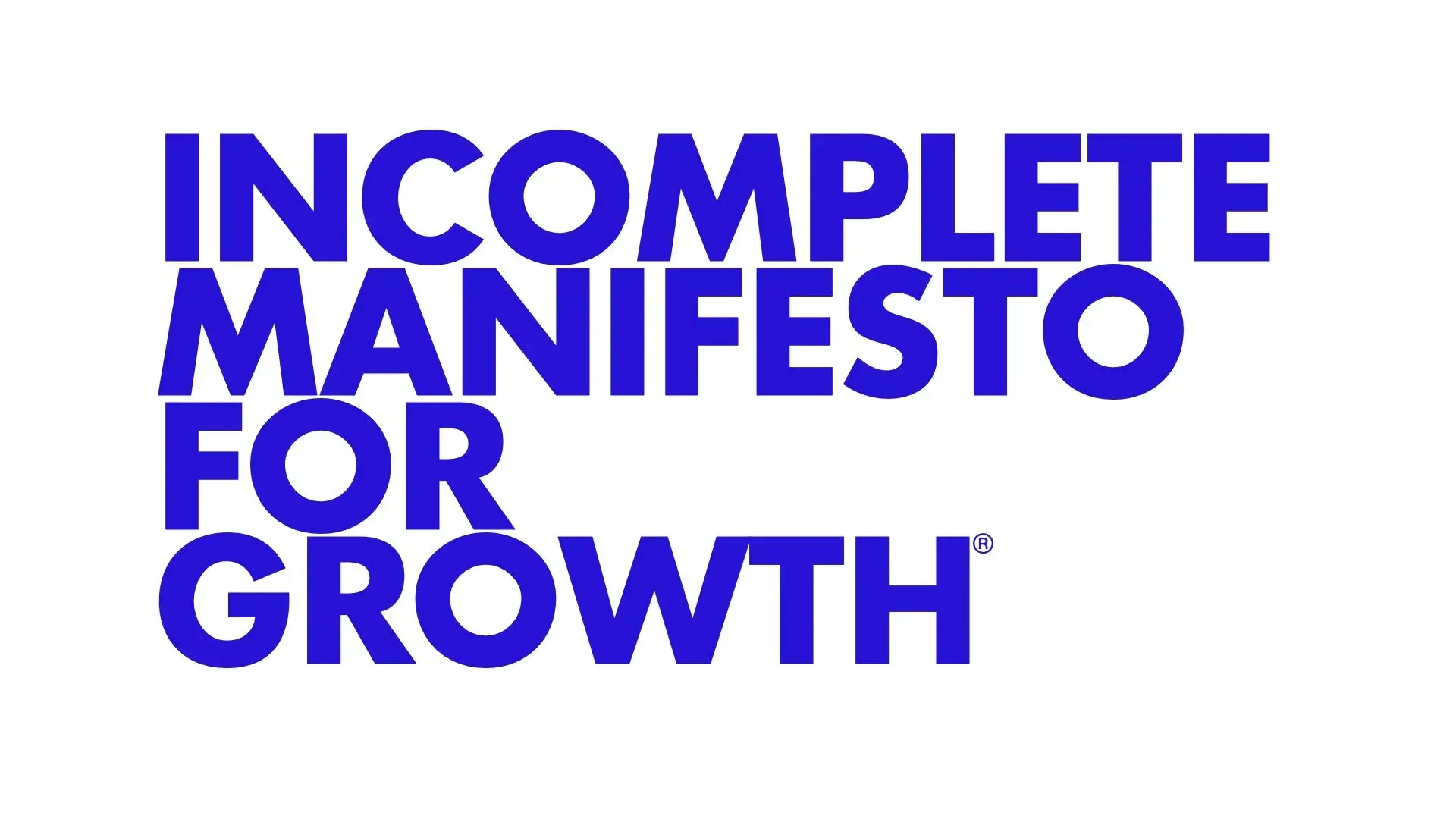
An Incomplete Manifesto for Growth by Bruce Mau, 1998

An Incomplete Manifesto for Growth

1998

Written in 1998 and first published in I.D. magazine (then edited by Chee Pearlman), An Incomplete Manifesto for Growth is a list of 43 principles for sustaining a creative practice. Mau drafted it as a personal document — a working answer to the question of how a studio maintains creative energy over time. When Pearlman asked to publish it, Mau agreed; the piece spread rapidly, was translated into dozens of languages and became one of the most widely circulated documents in design education. The manifesto is characteristically Mau in its refusal of resolution — it names itself incomplete and is structured as a series of short, open-ended provocations rather than instructions. Point 1: "Allow events to change you." The text remains freely available on Mau's website and has been used as a design project by students worldwide.
An Incomplete Manifesto for Growth (1998). Bruce Mau. First published in I.D. magazine. · Bruce Mau, 1998. massivechangenetwork.com. Statutory educational licence. · AU statutory
Massive Change book by Bruce Mau, Phaidon Press 2004

Massive Change

2004

Massive Change began as a commission from the Vancouver Art Gallery in 2003 for an exhibition examining design's role in reshaping the world. Mau developed the project through the Institute Without Boundaries, the postgraduate programme he co-founded with George Brown College in Toronto. Fourteen students researched, wrote and designed the exhibition, website, radio series and accompanying book. The Phaidon Press publication (2004) runs to 240 pages across 11 sections — energy, transportation, urbanism, materials, markets, military, information, biology, imaging, living and moving — and includes transcripts of interviews with designers, scientists and engineers. Mau's premise: "Massive Change is not about the world of design. It is about the design of the world." The exhibition toured internationally after its Vancouver opening.
Massive Change (Phaidon Press, 2004). Bruce Mau / Institute Without Boundaries. · Bruce Mau / Phaidon Press, 2004. Cover image via OpenLibrary. Statutory educational licence. · AU statutory

04

Influence and legacy

Mau’s influence runs through two streams: book design and design education. S,M,L,XL remains a reference point in both architecture and graphic design; its model of the large-format studio monograph as an argument rather than a document has been followed by many subsequent publications. Zone Books, whose visual identity Mau shaped for nearly two decades, is still in print and still carries his design direction in its DNA.

The Incomplete Manifesto has had a diffuse but measurable effect on design pedagogy. Its widespread circulation established Mau as a figure concerned with the conditions of practice rather than its products.

Massive Change influenced a generation of designers who understood their work in terms of systemic problems — climate, urbanism, public health — rather than visual communication in the conventional sense. The Institute Without Boundaries model, building postgraduate work around applied research into large problems, anticipated approaches that became more common in design education in the 2010s.

Mau received the AIGA Gold Medal in 2007, the Cooper Hewitt National Design Award in 2016, and was elected an Honorary Royal Designer for Industry in 2011.

Learn at TGDS

Mau’s idea that design is a form of intelligence — not decoration but a systematic way of reading and reshaping the world — is central to how we approach design thinking at TGDS:

Courses

  • Certificate IV in Design (CUA40720) — covers design thinking, communication design and conceptual development, giving students tools to work at the level of ideas as well as form.
  • Intensive Foundation Course — 11 modules covering design fundamentals including editorial design, typography and design process. Certificate of completion.

Further reading

Books

  • Rem Koolhaas and Bruce Mau, S,M,L,XL (Monacelli Press / 010 Publishers, 1995).
  • Bruce Mau, Jennifer Leonard and the Institute Without Boundaries, Massive Change (Phaidon Press, 2004).
  • Bruce Mau, Life Style (Phaidon Press, 2000).
  • Kathryn Simon, “Bruce Mau,” BOMB magazine (2000).
  • Eye Magazine, “Reputations: Bruce Mau” (Winter 2000).

Online

  • Bruce Mau, “An Incomplete Manifesto for Growth” (1998) — available at brucemaustudio.com.

Get Started.

You can enrol any day of the year. We are online and study is self-paced, there is no pressure. Enrol when you are ready to start, from anywhere in the world. If you would like to chat or email, feel free to get in touch.

Brochures, Phone Calls & Questions

You can download a free brochure, book a phone call with one of our course advisors, or simply ask a question.

Other ways to get in touch

Australia 1300 655 485

International +61 1300 655 485

Ask Anything info@thegraphicdesignschool.com

Get a quote accounts@thegraphicdesignschool.com

Acknowledgement of Country
The Graphic Design School acknowledges the Traditional Custodians of Country throughout Australia and their continued spiritual connection to land.
We pay respect to Elders past, present and emerging.
Always was, always will be.
RTO Provider № 91706